Can our readers help solve
a Hank Blum chassis mystery?
The Hank Blum story by Kevin Triplett
7/31/17 updated with detailed photos of the chassis to hopefully identify this car
7/31/17 updated with detailed photos of the chassis to hopefully identify this car
The aircraft industry and specifically Lockheed Aircraft was
fertile training ground for mid-century race car builder and fabricators.
Legendary car builder AJ Watson worked there and met engineer Henry “Hank”
Blum from Studio City California who
along with fellow Lockheed engineer Leroy Payne “engineered” the original AJ
Watson “Pots and Pans Special” championship car officially known as the “City
of Glendale Special.” The city did not actually have anything to do with the
program, but Watson’s shop and many of Watson’s buddies including Blum that
helped and chipped in parts and money lived in and around Glendale.
Dick Rathmann qualified the car 18th for the 1950
Indianapolis 500-mile race but finished 32nd after the crankshaft broke in the
Offenhauser engine built with other team’s cast-off parts. Hank Blum, Payne,
Jud Phillips and Ronnie Ward among others worked as Watson’s volunteer crew
which had better results at Milwaukee and Langhorne, before Joe James replaced
Rathmann as the driver when the team picked up sponsorship from Lincoln Mercury
dealer Bob Estes.
1951 Joe James drove the “Pots and Pans” machine at
Indianapolis but finished last with a broken driveshaft. James drove nine more
races in 1951 for the Watson/Estes combination and followed Watson when he went
to work for the Jack Zink team after the 1951 Detroit race. In 1952 Jim Rigsby
qualified the Estes sponsored Watson upright in third starting position and
finished 12th. In 1953, Don Freeland crashed the “Pots and Pans” machine on lap
76 in turn four.
It is unclear when he built it, but in 1956 Hank Blum
entered his own “long wheelbase” Wayne headed GMC-powered chassis, which could
race as either a championship car or a sprint car. The car was entered in a May 25 1956 sprint car race for Chuck Hulse held on the Willow Springs road course. Hulse qualified the Blum car more than 2 seconds a lap faster than the next qualifier, but after he won the feature by over a lap, he was penalized for a jump start and placed second behind Danny 'Termite" Jones.

Hulse obtained a United States Auto Club (USAC) license and drove the Blum car in the Pike’s Peak Hill climb. In the first of the Pikes Peak sanctioned non-points race, Hulse failed to finish his run up the mountain.
Chuck crashed 1/4 of the way up the hill and landed upside dangling above a huge drop off. Chuck now 90 years young, say "it could have been worse."
The #77 “Blum Engineering Special” returned to Pikes Peak the following year for driver Frank Sanborn who finished ninth, as he drove in place of Hulse who raced instead at a CRA (California Racing Association) sprint car event.
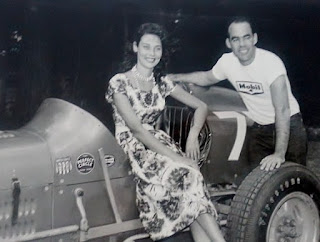

1956 news photo provided by Lee Hulse
Hulse obtained a United States Auto Club (USAC) license and drove the Blum car in the Pike’s Peak Hill climb. In the first of the Pikes Peak sanctioned non-points race, Hulse failed to finish his run up the mountain.
Chuck crashed 1/4 of the way up the hill and landed upside dangling above a huge drop off. Chuck now 90 years young, say "it could have been worse."
The #77 “Blum Engineering Special” returned to Pikes Peak the following year for driver Frank Sanborn who finished ninth, as he drove in place of Hulse who raced instead at a CRA (California Racing Association) sprint car event.

Betty and Chuck Hulse at Pikes Peak in 1958
Photo provided by Lee Hulse
Over the winter of 1957-1958, Watson was itching to make
more money by building additional cars beyond what the Zink team needed, and in
a financial partnership with Hank Blum built a roadster chassis “on spec” which
was entered at the Indianapolis Motor Speedway under Blum’s name.
The new roadster was sold to Lee Elkins and Dick Rathmann proceeded to put the ‘McNamara Special’ on the pole position for the start of the 1958 Indianapolis ‘500.’ On race day after a confusing start procedure with the 33 cars leaving single file from the pit area, Rathmann and Zink’s driver Ed Elisian eliminated themselves involved in the notorious turn three first lap wreck that took the life of Pat O’Connor.
The new roadster was sold to Lee Elkins and Dick Rathmann proceeded to put the ‘McNamara Special’ on the pole position for the start of the 1958 Indianapolis ‘500.’ On race day after a confusing start procedure with the 33 cars leaving single file from the pit area, Rathmann and Zink’s driver Ed Elisian eliminated themselves involved in the notorious turn three first lap wreck that took the life of Pat O’Connor.
In 1958 at Pike’s Peak Hulse returned as the driver of the
Blum/GMC car and finished eighth, then the ‘Blum Engineering Special’ missed
the starting field at Sacramento. During 1959, after Hulse had trouble finding
a regular CRA ride, Blum pulled the chassis out of storage and Hulse won CRA
two features.

Those victories which earned Hulse a shot in the new Roger McCluskey-built 270-cubic inch Offenhauser powered Alex Morales-owned “Tamale Wagon” with which Hulse captured the 1959 CRA championship. Hulse and Blum used the same “combination” chassis configured as a championship car at Sacramento and Phoenix but they missed the show at Phoenix and broke early during the race at the old California State Fairgrounds track.

First 1959 CRA win victory lane photo
provided by Lee Hulse
Those victories which earned Hulse a shot in the new Roger McCluskey-built 270-cubic inch Offenhauser powered Alex Morales-owned “Tamale Wagon” with which Hulse captured the 1959 CRA championship. Hulse and Blum used the same “combination” chassis configured as a championship car at Sacramento and Phoenix but they missed the show at Phoenix and broke early during the race at the old California State Fairgrounds track.
In 1962, Hank Blum used
a set of drawings he had engineered for Watson to build his own 4-torsion bar
suspended dirt car chassis which appeared as the #78 ‘Blum Engineering Special’
for Chuck Hulse at the Hoosier Hundred , Sacramento and Phoenix , the three
final dirt track races on the 1962 USAC Championship trail.
Hulse recorded two top ten finishes and liked the car’s handling so well that when he signed to drive for the “Dean Van Lines” team for 1963, he convinced team owner Dean and his chief mechanic Clint Brawner to lease the Blum chassis and it appeared in seven 1963 USAC races with a second place at the Phoenix season finale.
Hulse recorded two top ten finishes and liked the car’s handling so well that when he signed to drive for the “Dean Van Lines” team for 1963, he convinced team owner Dean and his chief mechanic Clint Brawner to lease the Blum chassis and it appeared in seven 1963 USAC races with a second place at the Phoenix season finale.
Over the winter of 1963-1964, Blum sold the chassis to the
team of Sid Weinberger and Frank Wilseck and it was raced the “Weinberger Homes
Special” in early 1964 by Johnny White. "Rookie" driver Gordon Johncock drove the car in four races later in the 1964 season after White
crashed a sprint car at Terre Haute in June 1964 and was permanently paralyzed
Also during 1963 Hank Blum and body man Wayne Ewing, a Watson employee, teamed up to build a new roadster chassis for Al Dean. There is some confusion as this car is referred to at various times as a “Blum” but more often as a “Ewing” and was driven in 1963 by Chuck Hulse which meant that all of Hulse's races in 1963 were behind the wheel of a Blum chassis. In 1964 and 1965 the Dean Van Lines Special Blum/Ewing roadster was driven by a young "rookie" named Mario Andretti.
Also during 1963 Hank Blum and body man Wayne Ewing, a Watson employee, teamed up to build a new roadster chassis for Al Dean. There is some confusion as this car is referred to at various times as a “Blum” but more often as a “Ewing” and was driven in 1963 by Chuck Hulse which meant that all of Hulse's races in 1963 were behind the wheel of a Blum chassis. In 1964 and 1965 the Dean Van Lines Special Blum/Ewing roadster was driven by a young "rookie" named Mario Andretti.
The original 1962 Blum dirt car chassis was driven as the “Weinberger
Homes Special” by Johncock and Roger McCluskey during the 1965 season, then at the 1965 USAC season finale at
Phoenix it was apparently leased to Al Dean and it was driven by Bud Tinglestad
as the “Dean Van Lines Special” as an insurance entry. The car was a back-up for Andretti to take over
if he encountered trouble in his regular Brawner Hawk. Andretti finished second
in the Hawk and captured the 1965 USAC driving championship as Tinglestad finished fifth.
Chuck Hulse drove the 1962 Blum/Offenhauser with "Dean Van
Lines" colors at the 1966 season opener at Phoenix as he returned from a
two-year layoff due to an eye injury and finished third.
Later in the year the 1962 Blum chassis was returned to Weinberger colors
and driven by Bobby Unser in four races who finished three of those races
in the top five. In 1967 still in Weinberger Homes colors, Johnny Rutherford drove
the 1962 Blum chassis in four dirt races and scored one top five finish.
The pilot of the Weinberger/Blum car for the 1968 and 1969
USAC seasons was Larry Dickson. in 1968
he entered four races with the Blum chassis, qualified for three races and
finished in the top 10 all three times, with a best finish of second place at
the Springfield Mile, which matched the 1963 Phoenix race as the car’s best-ever
finishes. In 1969, Dickson qualified for
four dirt starts in the Weinberger Blum chassis and scored two top five
finishes.

The 1962 Hank Blum chassis as raced
by the Mataka Brothers
Photographer unknown
After the 1969 season, Weinberger dropped out of USAC racing
and sometime later the Blum Chassis was sold to the Mataka Brothers, William
and Ed of New Jersey who raced the car still Offenhauser powered as the “Raceweld
Special” for three USAC races in 1971, driven by Joe Saldana and in one race by
Jerry Karl. The 'Raceweld' Blum chassis appeared in four USAC races in 1972
driven by Saldana for the first race and then the rest of the season by Carl
Williams.
In 1973 Arizona’s “Bronco” Billy Shuman drove the Raceweld car
in three races but failed to finish any of them. Joe Saldana returned to the
seat for the 1974 season, but it unclear whether the Blum chassis was still
Offenhauser powered that season. The 1962
Blum dirt car chassis was apparently retired by the Mataka brothers after the
1974 Hoosier Hundred.
During its 12-year
USAC racing career, the 1962 Hank Blum chassis was driven by some legendary names
Rutherford, Johncock, Bobby Unser, Saldana and Dickson, and the other lesser-known Hank
Blum-built chassis were driven by Chuck Hulse and Mario Andretti, mighty
accomplishments for a man who was an aircraft engineer and not a full-time race car builder.
Now for the mystery – by Tom David
David Tom the current owner of the pictured car bought the car from
Ken Hillberg in 2016 after it had been restored during the period of 2000 to
2002. The restoration work was done using the original chassis and included the
roll bar, seat, fuel tank, Halibrand steering brakes, wheels, quick change
rear, and several other parts. Hillberg acquired the car in a trade with Jim
Travis who found the car in the car in the mid-1990's at a swap meet in
Southern California. At that time the
car had a distinct "Silver Crown" appearance with a bolt on cage that
utilized the existing main hoop as a welding point.


These restoration photos were provided by David Tom
There are no known photos of the car as it was found by
Travis but we have a few of restoration photos as the car neared the
completion. It is a 96" wheelbase car restored as a transverse leaf spring
front, but there are clearly signs that it could have been a four link front at
one time. The owner Mr. Tom was told that it was a Grant King car.
There is evidence on the chassis that there was significant
damage in the left front at one time, therefore the Grant King claim may
originate from King making repairs to the car at one time which include the
replacement of the axle. A Grant King
style fiberglass engine cover fiberglass nose and aluminum grill were used in
the restoration which also used a fiberglass Edmunds sprint car tail was used
with 4 inches being added to the front to make it appear as a Champ car tail.
The hand-formed aluminum fuel tank appears to be original to
the chassis and pre-dates the use of a bladder although there is now a bladder
in the tank. The aluminum seat is claimed to be original to the chassis. The seat has cutouts for a "Sam
Brown" belt although it has been modified for a later five-point system
and right shoulder bolster support.


Detailed photographs of the
engine installation from David Tom
The
car had a Chevrolet small block engine installed when David Tom got it but that
engine clearly does not optimally fit into the chassis. The upper frame rails (front) force the Chevrolet
engine to be mounted about 1.5 inches too high to enable the removal of the
spark plugs. Mr. Tom believes the
chassis was originally built for an Offenhauser engine and no attempt was made
to reform the upper chassis bars.
The owner David Tom suspects that this may be the first Hank
Blum car built in the nineteen fifties which raced with CRA (as a sprint car)
and as a USAC championship car at Pikes Peak. Unfortunately neither Mr. Tom nor
the author has had any success locating period photographs of the first Blum
chassis which could be used to help identify this car.
7/31/17 UPDATE Here are some newly found photos that show details of the car's construction


7/31/17 UPDATE Here are some newly found photos that show details of the car's construction


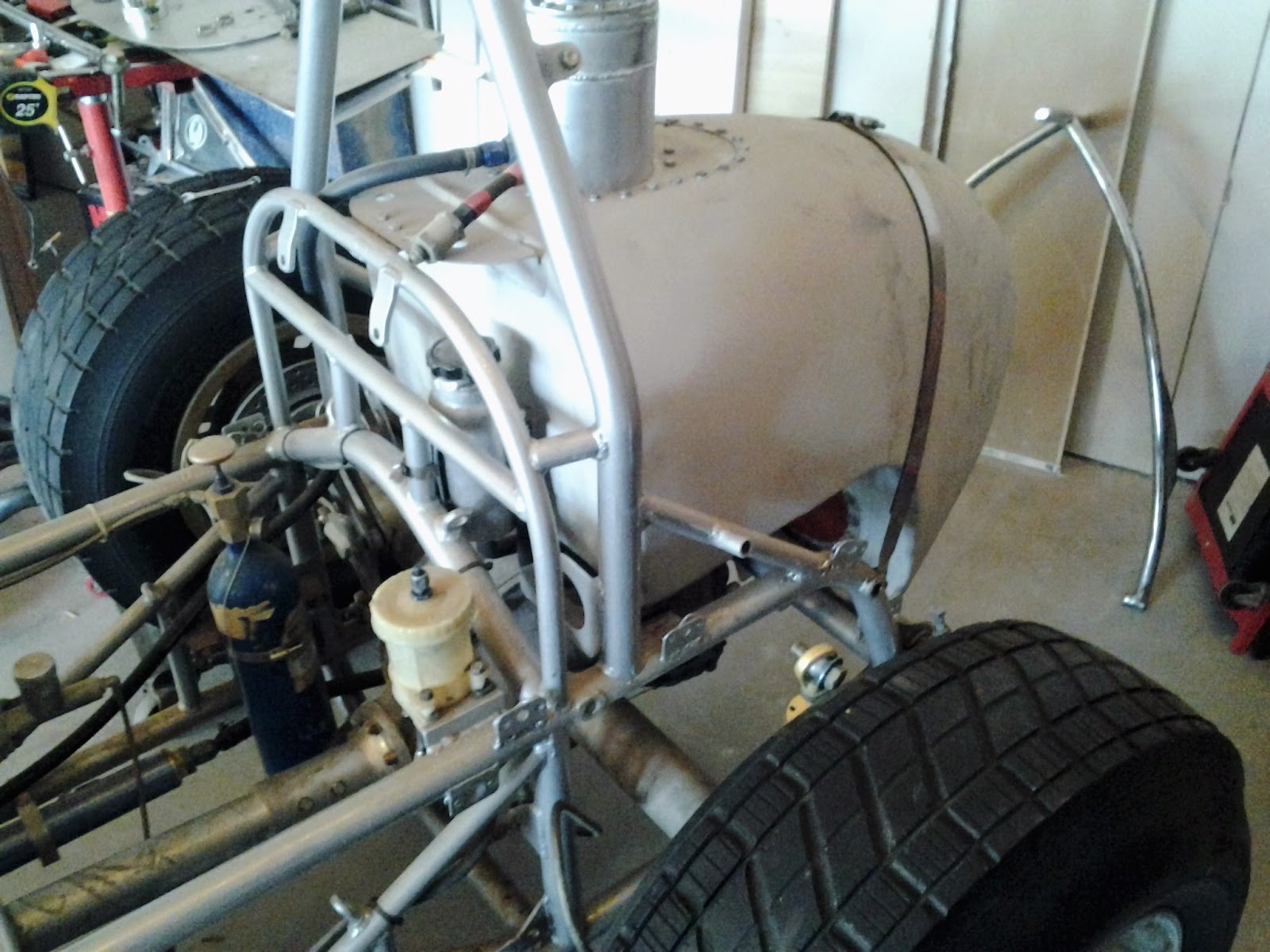

Can any of our loyal readers help verify the identity of
this car? Contact the author with tips and leads at kevracerhistory@aol.com
