Showing posts with label USAC. Show all posts

Wednesday, May 2, 2018


An open letter regarding the future of 
West Coast pavement sprint car racing.

My name is Jeff Trout.  For those of you not familiar with me, my history is that I raced in several forms of oval racing, dirt and pavement, in California from the early 90's until the early 2000s.  I was a Bay Cities Racing Association (BCRA) board member as well as a competitor and car owner.  I also raced late models and tracks.  I made two starts in a pavement sprint car with the United States Auto Club (USAC) and I must say that was the best racing of my life.  Recently, I've been involved in road racing, which I will discuss later.

 I have been looking at how to improve pavement sprint car racing on the west coast for a couple of years. It started when I decided to get back into oval racing after spending a few years with another fellow BCRA racer, Richard Miglori, racing sports cars.  During that time, I learned a lot about the Chevrolet Gen III/IV engines like the current Knoxville sealed sprint car motor (CT525) and Tim Schwanke's sealed sprint car engines.

I was at a Northern California Modified Association (NCMA) meeting recently and gathered information on what their plans were for this season and to submit a request to try a new engine, an LS that I would have built, tested on a dynamometer, sealed and then submitted for approval to NCMA to run on an exhibition status as a proof of concept.

I feel that this engine can reduce costs, especially maintenance costs.  We road raced a stock LS3 engine (except for a cam change) for 4 years in endurance races from 3 hours to 25 hours for four years with only an annual valve change with zero engine failures! 
In the Midwest, they use the LS engine in two sprint car series and they have saved their sprint car series.  they have gone from a hand full of cars at one track to over 100 cars at several tracks over two series about 200 miles apart.  Admittedly, it is dirt, but I feel the business model is the same.

After my discussions with the Midwestern racers, I concluded that with their help, I can put together something that in the short term can increase car count and exposure while lowering the cost of racing a sprint car and provide a competitive playing field. 


It is my pleasure to announce that my company, Pacific Racing League, LLC has acquired a national sanction with Performance Open Wheel Racing, Inc. (POWRi) to hold pavement sprint car races under the POWRi Pacific Sprint Series banner. This sanction will bring sponsors, and exposure through POWRi's in-house TV company,
We plan on making the series an experience for racers and fans on and off the track with a lot of innovative marketing ideas. I named my company Pacific Racing League, because I plan to use what I have learned working for the Anaheim Ducks and approach this venture as a sports league, treating each car owner, driver and track promoter as a partner in our success.

The key to this series, short term, is to use rules that have been proven to equalize the competition around different engine combinations using balance of power measures with weight and restrictions on the most powerful engines to increase car count, and therefore leverage that growth with local track promoters. 
Hopefully, racers can use what they have be competitive.  The physics of pavement, non-wing sprint cars is that less power and less weight can be competitive against high horsepower, heavier cars because they hook up much better and can use all their power band. This has been proven in several pavement stock car series that run engines that make from 385 to 600 horsepower (HP) together.

We plan on putting on some demonstrations later this year with the potential for a race or two toward the end of the year and a 12-race schedule in 2019. We have already extended an invitation to enter a co-sanction of these events with NCMA. 

You can find out more at http://prlsprints.com/  and we are on twitter at @pacificsprints and on Facebook at POWRi Pacific Sprints, or you can email me at jtrout@powripacific.com.

I look forward to working with all of you and please spread the word.

 Thank You

Jeff Trout

 President, POWRi Pacific Sprint Series

 8605 Santa Monica Blvd #52394

 West Hollywood, California 90069-4109

 (805) 380-8106

Monday, May 22, 2017

Can our readers help solve 
a Hank Blum chassis mystery?  

The Hank Blum story by Kevin Triplett

7/31/17 updated with detailed photos of the chassis to hopefully identify this car

The aircraft industry and specifically Lockheed Aircraft was fertile training ground for mid-century race car builder and fabricators. Legendary car builder AJ Watson worked there and met engineer Henry “Hank” Blum  from Studio City California who along with fellow Lockheed engineer Leroy Payne “engineered” the original AJ Watson “Pots and Pans Special” championship car officially known as the “City of Glendale Special.” The city did not actually have anything to do with the program, but Watson’s shop and many of Watson’s buddies including Blum that helped and chipped in parts and money lived in and around Glendale.

Dick Rathmann qualified the car 18th for the 1950 Indianapolis 500-mile race but finished 32nd after the crankshaft broke in the Offenhauser engine built with other team’s cast-off parts. Hank Blum, Payne, Jud Phillips and Ronnie Ward among others worked as Watson’s volunteer crew which had better results at Milwaukee and Langhorne, before Joe James replaced Rathmann as the driver when the team picked up sponsorship from Lincoln Mercury dealer Bob Estes.  

1951 Joe James drove the “Pots and Pans” machine at Indianapolis but finished last with a broken driveshaft. James drove nine more races in 1951 for the Watson/Estes combination and followed Watson when he went to work for the Jack Zink team after the 1951 Detroit race. In 1952 Jim Rigsby qualified the Estes sponsored Watson upright in third starting position and finished 12th. In 1953, Don Freeland crashed the “Pots and Pans” machine on lap 76 in turn four.  

It is unclear when he built it, but in 1956 Hank Blum entered his own “long wheelbase” Wayne headed GMC-powered chassis, which could race as either a championship car or a sprint car. The car was entered in a May 25 1956 sprint car race for Chuck Hulse held on the Willow Springs road course. Hulse qualified the Blum car more than 2 seconds a lap faster than the next qualifier, but after he won the feature by over a lap, he was penalized for a jump start and placed second behind Danny 'Termite" Jones.


1956 news photo provided by Lee Hulse


Hulse obtained a United States Auto Club (USAC) license and drove the Blum car in the Pike’s Peak Hill climb. In the first of the Pikes Peak sanctioned non-points race, Hulse failed to finish his run up the mountain. 

Chuck crashed 1/4 of the way up the hill and landed upside dangling above a huge drop off. Chuck now 90 years young, say "it could have been worse."  

The #77 “Blum Engineering Special” returned to Pikes Peak the following year for driver Frank Sanborn who finished ninth, as he drove in place of Hulse who raced instead at a CRA (California Racing Association) sprint car event.  

Betty and Chuck Hulse at Pikes Peak in 1958
Photo provided by Lee Hulse
 

Over the winter of 1957-1958, Watson was itching to make more money by building additional cars beyond what the Zink team needed, and in a financial partnership with Hank Blum built a roadster chassis “on spec” which was entered at the Indianapolis Motor Speedway under Blum’s name.

The new roadster was sold to Lee Elkins and Dick Rathmann proceeded to put the ‘McNamara Special’ on the pole position for the start of the 1958 Indianapolis ‘500.’ On race day after a confusing start procedure with the 33 cars leaving single file from the pit area, Rathmann and Zink’s driver Ed Elisian eliminated themselves involved in the notorious turn three first lap wreck that took the life of Pat O’Connor.  

In 1958 at Pike’s Peak Hulse returned as the driver of the Blum/GMC car and finished eighth, then the ‘Blum Engineering Special’ missed the starting field at Sacramento. During 1959, after Hulse had trouble finding a regular CRA ride, Blum pulled the chassis out of storage and Hulse won CRA two features.


First 1959 CRA win victory lane photo
provided by Lee Hulse 


Those victories which earned Hulse a shot in the new Roger McCluskey-built 270-cubic inch Offenhauser powered Alex Morales-owned “Tamale Wagon” with which Hulse captured the 1959 CRA championship.  Hulse and Blum used the same “combination” chassis configured as a championship car at Sacramento and Phoenix but they missed the show at Phoenix and broke early during the race at the old California State Fairgrounds track.

In 1962,  Hank Blum used a set of drawings he had engineered for Watson to build his own 4-torsion bar suspended dirt car chassis which appeared as the #78 ‘Blum Engineering Special’ for Chuck Hulse at the Hoosier Hundred , Sacramento and Phoenix , the three final dirt track races on the 1962 USAC Championship trail.

Hulse recorded two top ten finishes and liked the car’s handling so well that when he signed to drive for the “Dean Van Lines” team for 1963, he convinced team owner Dean and his chief mechanic Clint Brawner to lease the Blum chassis and it appeared in seven 1963 USAC races with a second place at the Phoenix season finale.  

Over the winter of 1963-1964, Blum sold the chassis to the team of Sid Weinberger and Frank Wilseck and it was raced the “Weinberger Homes Special” in early 1964 by Johnny White. "Rookie" driver Gordon Johncock drove the car in four races later in the 1964 season after White crashed a sprint car at Terre Haute in June 1964 and was permanently paralyzed  

Also during 1963 Hank Blum and body man Wayne Ewing, a Watson employee, teamed up to build a new roadster chassis for Al Dean. There is some confusion as this car is referred to at various times as a “Blum” but more often as a “Ewing” and was driven in 1963 by Chuck Hulse which meant that all of Hulse's races in 1963 were behind the wheel of a Blum chassis. In 1964 and 1965 the Dean Van Lines Special Blum/Ewing roadster was driven by a young "rookie" named Mario Andretti.  

The original 1962 Blum dirt car chassis was driven as the “Weinberger Homes Special” by Johncock and Roger McCluskey during the 1965 season, then at the 1965 USAC season finale at Phoenix it was apparently leased to Al Dean and it was driven by Bud Tinglestad as the “Dean Van Lines Special” as an insurance entry. The car was a back-up for Andretti to take over if he encountered trouble in his regular Brawner Hawk. Andretti finished second in the Hawk and captured the 1965 USAC driving championship as Tinglestad finished fifth.

Chuck Hulse drove the 1962 Blum/Offenhauser with "Dean Van Lines" colors at the 1966 season opener at Phoenix as he returned from a two-year layoff due to an eye  injury and finished third.  Later in the year the 1962 Blum chassis was returned to Weinberger colors and  driven by Bobby Unser in four races who finished three of those races in the top five. In 1967 still in Weinberger Homes colors, Johnny Rutherford drove the 1962 Blum chassis in four dirt races and scored one top five finish.

The pilot of the Weinberger/Blum car for the 1968 and 1969 USAC seasons was Larry Dickson.  in 1968 he entered four races with the Blum chassis, qualified for three races and finished in the top 10 all three times, with a best finish of second place at the Springfield Mile, which matched the 1963 Phoenix race as the car’s best-ever finishes.  In 1969, Dickson qualified for four dirt starts in the Weinberger Blum chassis and scored two top five finishes.
 
 
The 1962 Hank Blum chassis as raced
by the Mataka Brothers
Photographer unknown
 

After the 1969 season, Weinberger dropped out of USAC racing and sometime later the Blum Chassis was sold to the Mataka Brothers, William and Ed of New Jersey who raced the car still Offenhauser powered as the “Raceweld Special” for three USAC races in 1971, driven by Joe Saldana and in one race by Jerry Karl. The 'Raceweld' Blum chassis appeared in four USAC races in 1972 driven by Saldana for the first race and then the rest of the season by Carl Williams.

In 1973 Arizona’s “Bronco” Billy Shuman drove the Raceweld car in three races but failed to finish any of them. Joe Saldana returned to the seat for the 1974 season, but it unclear whether the Blum chassis was still Offenhauser powered that season.  The 1962 Blum dirt car chassis was apparently retired by the Mataka brothers after the 1974 Hoosier Hundred. 
During its 12-year USAC racing career, the 1962 Hank Blum chassis was driven by some legendary names Rutherford, Johncock, Bobby Unser, Saldana and Dickson, and the other lesser-known Hank Blum-built chassis were driven by Chuck Hulse and Mario Andretti, mighty accomplishments for a man who was an aircraft engineer and not a full-time race car builder.   

Now for the mystery – by Tom David

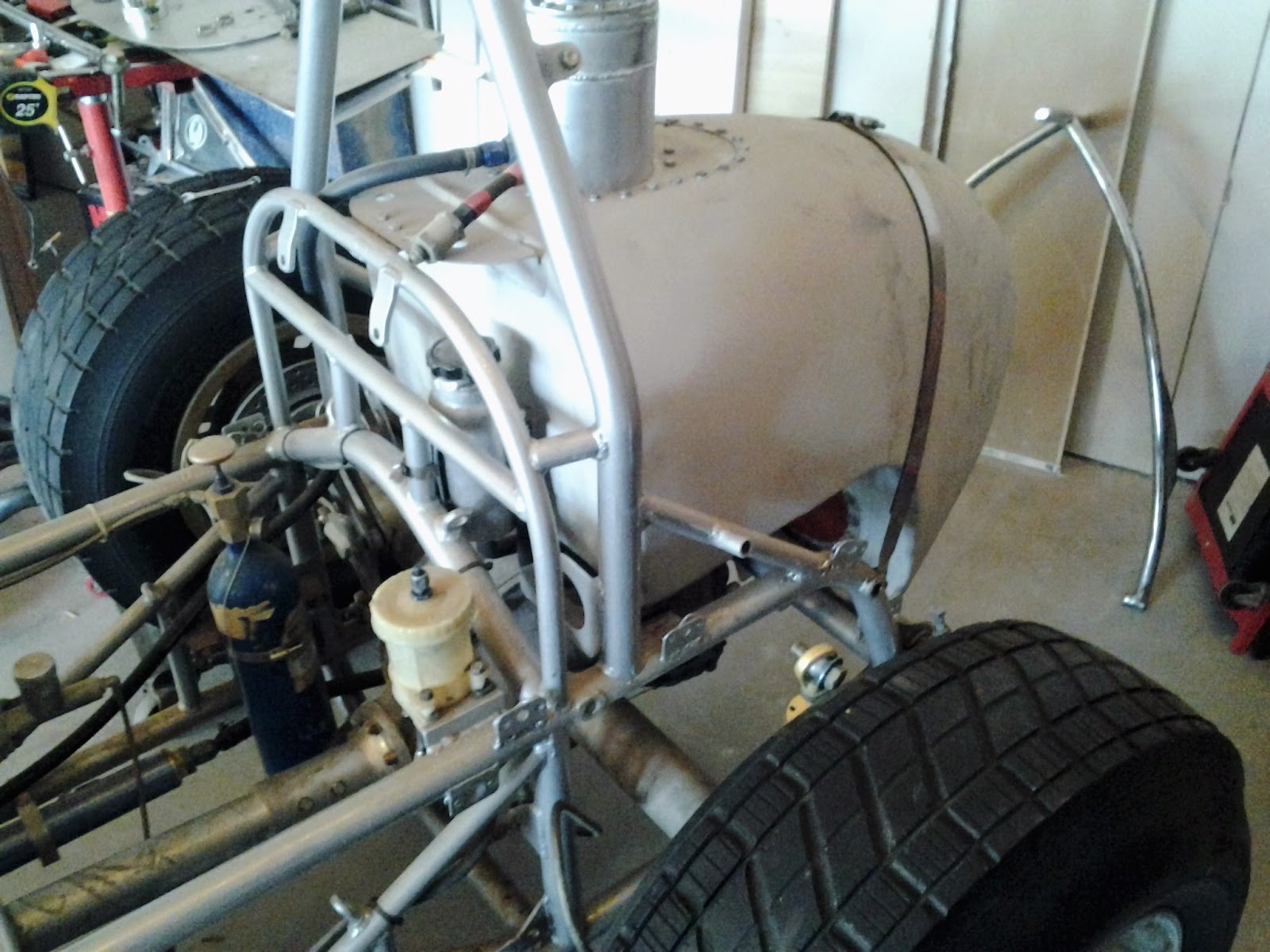
David Tom the current owner of the pictured car bought the car from Ken Hillberg in 2016 after it had been restored during the period of 2000 to 2002. The restoration work was done using the original chassis and included the roll bar, seat, fuel tank, Halibrand steering brakes, wheels, quick change rear, and several other parts. Hillberg acquired the car in a trade with Jim Travis who found the car in the car in the mid-1990's at a swap meet in Southern California.  At that time the car had a distinct "Silver Crown" appearance with a bolt on cage that utilized the existing main hoop as a welding point. 


These restoration photos were provided by David Tom
 

There are no known photos of the car as it was found by Travis but we have a few of restoration photos as the car neared the completion. It is a 96" wheelbase car restored as a transverse leaf spring front, but there are clearly signs that it could have been a four link front at one time. The owner Mr. Tom was told that it was a Grant King car.

There is evidence on the chassis that there was significant damage in the left front at one time, therefore the Grant King claim may originate from King making repairs to the car at one time which include the replacement of the axle.  A Grant King style fiberglass engine cover fiberglass nose and aluminum grill were used in the restoration which also used a fiberglass Edmunds sprint car tail was used with 4 inches being added to the front to make it appear as a Champ car tail.  

The hand-formed aluminum fuel tank appears to be original to the chassis and pre-dates the use of a bladder although there is now a bladder in the tank. The aluminum seat is claimed to be original to the chassis.  The seat has cutouts for a "Sam Brown" belt although it has been modified for a later five-point system and right shoulder bolster support. 


Detailed photographs of the
engine installation from David Tom
 
The car had a Chevrolet small block engine installed when David Tom got it but that engine clearly does not optimally fit into the chassis.  The upper frame rails (front) force the Chevrolet engine to be mounted about 1.5 inches too high to enable the removal of the spark plugs.  Mr. Tom believes the chassis was originally built for an Offenhauser engine and no attempt was made to reform the upper chassis bars.  

The owner David Tom suspects that this may be the first Hank Blum car built in the nineteen fifties which raced with CRA (as a sprint car) and as a USAC championship car at Pikes Peak. Unfortunately neither Mr. Tom nor the author has had any success locating period photographs of the first Blum chassis which could be used to help identify this car.

7/31/17 UPDATE Here are some newly found photos that show details of the car's construction


Can any of our loyal readers help verify the identity of this car?  Contact the author with tips and leads at kevracerhistory@aol.com

Wednesday, December 16, 2015


Unser Gibbs and Hendrick

2016 NMPA Hall of Fame inductees

 By Kevin Triplett


Three legendary names in motorsports have been chosed for induction into the National Motorsports Press Association (NMPA) Hall of Fame. Four-time Indianapolis 500 winner and three-time IndyCar champion driver Al Unser along with NASCAR (National Association of Stock Car Racing) multi-championship team owners Rick Hendrick and Joe Gibbs make up the 2016 NMPA Hall of Fame induction class.  

Hendrick received 88 percent of the votes cast by NMPA members, while Gibbs received 76 percent and Unser received 66 percent. Curiously, fellow four-time Indianapolis 500 winner Rick Mears also received votes but not enough for election into the NMPA Hall of Fame.
 
Al Unser in 1987

The Unser family name appears frequently in the annals of open-wheel racing history, with no less than six family members who have driven in the Indianapolis 500-mile race, but no member of the Unser family has achieved more racing success than Alfred “Al” Unser.

The Albuquerque, New Mexico native born May 29 1939 the youngest of four sons enjoyed a career that most racers only dream about, including being one of only three drivers (others are A.J. Foyt and Rick Mears) to win the legendary Indianapolis 500 four separate times and is the only driver to have both a brother (Bobby) and son (Al Jr.) as fellow Indianapolis ‘500’ champions.

Unser made his first USAC (United States Auto Club) oval track start at the one-mile Wisconsin State Fairgrounds in Milwaukee on August 23 1964 behind the wheel of J.C. Agajanian’s unloved Offenhauser powered Troutman rear engine car. Al spent most of the 1965 USAC season as the driver of Jerry Eisert’s #96 Harrison Special, but his big break came at the 1965 Indianapolis 500-mile race when he qualified Texan John Mecom’s Lola T70 in a last minute deal and went on to finish in ninth place.

Unser drove for the Mecom Racing team through the 1968 USAC season before the team was sold and became Vel’s Parnelli Jones (VPJ) Racing in 1969. Behind the wheel of a VPJ 'Johnny Lightning Special’ Colt/Ford, Unser won the 1970 Indianapolis ‘500’ in dominating fashion, as he led 190 of 200 laps. Unser went on to win the 1970 USAC National drivers’ championship with 10 race victories during the season.

Unser repeated as the 1971 Indianapolis 500 champion, and continued to drive for the VPJ Racing team through the 1977 season. In 1978, Unser drove Jim Hall’s ‘First National City Travelers Checks Special’ Lola 78/Cosworth and captured his third Indianapolis ‘500’ crown. 

After just  two seasons, Unser left Hall at the end of the 1979 season in a regrettable move to Bobby Hillin Senior’s Longhorn Racing Team, and over the next three seasons, Unser and the uncompetitive team struggled and notched no race wins. His replacement at Hall, drove the radical ground effects Chaparral/Cosworth to five wins in 1980, including the 1980 Indianapolis '500.' 

Al’s career rebounded when he joined Penske Racing in 1983 and in his first six races with his new team, he never finished worse than third and by his consistency won the 1983 CART (Championship Auto Racing Teams) championship. In 1987, Al started the season without a ride, and only got his ride at the Indianapolis Motor Speedway after Danny Ongais destroyed his Penske PC-16/Chevrolet entry in practice, suffered a concussion and was not medically cleared to drive.

After three days of practice, Al qualified for the 20th starting position on the second weekend in a 1986 March chassis powered by a Cosworth engine which began the month of May as an inoperable show car.  Al dodged a first lap spin by Josele Garza, and went on to win his fourth Indianapolis ‘500,’ as he and his Cummins/Holset Turbo sponsored entry led the last 18 laps after leader Roberto Guerrero stalled on his final pit stop.

Al Unser led 15 laps in Kenny Bernstein’s Budweiser Lola/Chevy in his 27th and what proved to be his final Indianapolis ‘500’ appearance in 1993. Al was entered for the 1994 Indianapolis ‘500’, in an underfunded Lola T9400/Ford, but announced his retirement on May 17, 1994, just days before his 55th birthday.  As reported by the New York Times, Unser stated “I always said if the day came when I wasn't producing the right way, if I wasn't happy, I'd get out.  I think the time has come. I'm not all there with the race car, so I decided to pull back and retire."  Al Unser Junior went on to win his first Indianapolis '500' on his father's 55th birthday.

Al Unser’s career statistics at the Indianapolis Motor Speedway are amazing: He leads all driver in laps led with 644, is ranked second in the number of races led with 11, and stands second in total race mileage with 10,890 miles (4,356 laps)  completed.  Al scored three season championships and 39 championship car victories on surfaces that included dirt ovals, paved ovals and road courses.  He remains active with The Unser Racing Museum in Albuquerque, New Mexico.   


 Rick Hendrick, right, with Ray Evernham, left,
at the Indianapolis Motor Speedway in 1994

Born in 1949, Joseph Riddick “Rick” Hendrick III was raised on the family farm near Palmer Springs, Virginia, and at 27 became the youngest Chevrolet dealer in the United States and built the Hendrick Automotive Group into an empire which is listed as the sixth-largest automotive group in the country with 73 dealerships. Hendrick was the inspiration for the “Tim Daland” character in the 1990 film Days of Thunder.

Since its first race, the 1984 Daytona 500 and its first win seven races later with Geoff Bodine at Martinsville (Virginia) Speedway, Hendrick Motorsports has amassed countless NASCAR records in its 32-year existence. Among the most notable: 14 NASCAR driver championships, including 11 in the premier Winston Nextel and Sprint Cup Series and 14 owner championships across three national series.


Joe Gibbs at the Indianapolis Motor Speedway in 1994 

Joe Jackson Gibbs’ eye for talent and the ability to mold individuals into champions has made him successful in both the National Football League (NFL)  and NASCAR. In 16 seasons as an NFL head coach, the Mocksville, North Carolina native compiled an overall won-loss record of 171-101 and three Super Bowl championships with the Washington DC NFL franchise.

In 23 seasons as a NASCAR team owner, Gibbs’ teams have won four NASCAR Cup-level championships, with Bobby Labonte, Tony Stewart and the 2015 series title with Kyle Busch, and 128 Sprint Cup race wins. Joe Gibbs Racing once involved in NHRA (National Hot Rod Association) team ownership has also compiled four Nationwide/XFINITY Series owner and one driver championships also with Kyle Busch and 112 race wins.

The trio of motorsports legends will be officially inducted in ceremonies to be held at the Embassy Suite hotel in Concord, North Carolina on January 16, 2016. The NMPA Hall of Fame is located on the grounds of Darlington Raceway in Darlington North Carolina and is open from 10 a.m. to 4 p.m. Monday – Friday.


Some of the information contained in this article was provided by the National Motorsports Press Association (NMPA) of which the author is a member.
 
The photographs that accompany this article appear courtesy of the Indianapolis Motor Speedway Collection in the IUPUI University Library Center of Digital Scholarship.  

Monday, July 27, 2015

A step back to racing tradition!


In the 'good old days' of racing history, Indianpolis '500' drivers also drove sprint cars and midget cars in events held at racing venues all across our country. The local appearances by the national cars and stars at the local tracks helped to "build the brand" of Indianapolis car racing. 

Last Saturday night, that tradition returned as IndyCar Series rookie Gabby Chavez shocked the midget racing world by finishing fifth in his first-ever midget car race start in the 'Tony Stewart Classic' held July 25 2015 at the historic 1/5-mile Lincoln Tech Indianapolis Speedrome oval located on Indianapolis’ east side.

In addition to the induction of the 2015 USAC United States Auto Club Hall of Fame class that included midget car champions Jimmy Caruthers, Don Kenyon, Larry Rice, Clark ‘Shorty’ Templeman, and Ron ‘Sleepy’ Tripp, the 100-lap 'Tony Stewart Classic' also featured the unique Shepherd Insurance ‘Tail Gunner Challenge.’ 

The leader at the mandatory 75-lap intermission was offered the opportunity to take the ‘Tail Gunner Challenge’ - restart at the tail of the field, and if after 25 laps he was able to win the race, he would capture the ‘Tail Gunner’ $10,000 bonus in addition to the $5,000 winner’s purse. If the leader declined, the offer would be extended to the second place driver, and if he also declined, the third place driver could take up the ‘Tail Gunner Challenge.’   

No one in the insurance business understands the racing business better than the Shepherd Insurance motorsports team, which is led by race team owner Tom Johnson and his son Jeff. Together, the Johnson’s have over 50 years of experience insuring motorsports teams and are charter members of the Indiana Motorsports Association. Shepherd Insurance knows exactly what racers need, because Tom and Jeff eat, drink and breathe racing. Contact Shepherd Insurance through their website at http://www.shepherdins.com

Gabriel ‘Gabby’ Chavez, the 22-year old Colombian IndyCar Series rookie and 2014 Indy Lights champion had never driven a midget race car prior to his first Friday afternoon practice session. Chavez drove the #9C Honda HPD sponsored midget owned by USAC, which is powered by the Honda HPD K24 146-cubic inch double overhead camshaft (DOHC) 4-cylinder USAC HPD midget series ‘spec engine.’ Chavez’ entry likely produced 150 horsepower less than the USAC Honda National Midget Series race cars he competed against in the Tony Stewart Classic.

Chavez completed time trials with his HPD #9C machine eleventh fastest overall of the 23 qualifiers, just two-tenths of a second behind 'Bowes Seal Fast' fastest qualifier Grant Galloway.  Chavez then finished second in his heat race behind Joey Burrow to advance into the 25-car feature starting field. After starting the feature in eleventh position, by the 75-lap intermission, Chavez had moved into third place.

Leader Kyle Hamilton of Danville Indiana declined to accept the Shepherd Insurance “Tail Gunner Challenge,’ as did second place driver Galloway. Chavez, in third place, accepted the challenge to the delight of the spectators, and over the final 25 green flag laps raced from the tail of the field back up to fifth place at the drop of the checkered flag behind Hamilton, Galloway, Kevin Studley, and Ross Rankine. 
Although he fell short of winning the race and the $10,000 Shepherd Insurance bonus, the young Columbian racer gained the respect and admiration of many long-time midget racing fans with his exciting first-time midget racing performance.    

Monday, June 29, 2015

'Tail Gunner Challenge' bonus posted for the inaugural Tony Stewart Midget Classic


Shepherd Insurance is offering an exciting $10,000 bonus for the final segment of the 100-lap Tony Stewart Midget Classic on July 25 at the historic fifth-mile Lincoln Tech Indianapolis Speedrome oval.

The Tony Stewart Midget Classic will feature a 100-lap main event broken into two segments. The first segment will be 75 laps followed by a 25-lap dash to the finish, with a 20 minute break. During the mandatory intermission which will see teams pitted in the infield for adjustments and tire changes, the 'Tail Gunner Challenge' will be presented to the leader of the race.

The leader will be asked if he or she would like to take the Shepherd Insurance ‘Tail Gunner Challenge,’ and restart at the rear of the field when the race resumes. If the tail gunner is able to make it back to the front in those final 25 green flag laps and win the Tony Stewart Midget Classic, the winner will take home a $10,000 bonus in addition to the $5,000 winner’s check.

If the leader at the 75-lap mark declines to take the Shepherd Insurance ‘Tail Gunner Challenge’ and stay in first place, the offer will then be made to the second-place driver. If the race runner-up also decides to not take the $10,000 gamble, the final 'Tail Gunner' offer will be made to the third-place driver.


No one knows the racing insurance business better than the Shepherd Insurance motorsports team, which is led by race team owner Tom Johnson and his son Jeff. Together, the Johnson’s have over 50 years of experience insuring motorsports teams and are charter members of the Indiana Motorsports Association. Shepherd Insurance knows exactly what racers need, because Tom and Jeff eat, drink and breathe racing. Contact Shepherd Insurance through their website at http://www.shepherdins.com


For more details and to purchase tickets for the Tony Stewart Midget Classic, visit the Indianapolis Speedrome website at http://www.speedrome.com

Tuesday, March 31, 2015


INAUGURAL "TONY STEWART CLASSIC" SET FOR JULY 25 
 
Information proved by the USAC Press Office
                                                                                                                                                   

United Auto States Auto Club (USAC) midget racers will join racers from numerous other midget racing groups at the inaugural 100-lap ‘Tony Stewart Classic’ Midget race scheduled for July 25 2015 at the historic Lincoln Tech Indianapolis Speedrome in the Hoosier capital.

The special ‘Tony Stewart Classic’ non-points event will bring together midget racers from across the country for what promises to be an exciting night of pavement short-track racing on the track which has hosted more USAC races than any  other track in history.

494 total USAC races have been contested on the one-fifth mile paved oval located on Kitley Avenue on Indianapolis' southeast side. USAC racing at the Indianapolis Speedrome dates back to August 1958 when Gene Hartley, the winner of USAC's first-ever race in 1956 won a 50-lap Midget feature. Hartley later promoted the Speedrome along with fellow retired race car driver Leroy Warriner.

Indianapolis Speedrome Managing Partner Larry Curry is extremely encouraged by the support the racing community has offered in regards to this challenging event, scheduled for the night before the ‘Crown Royal 400 at the Brickyard’ NASCAR (National Association of Stock Car Racing) Sprint Cup series race at the Indianapolis Motor Speedway.

"We are all very excited to have the opportunity to have such a great event in honor of Tony Stewart, who scored his first USAC feature win on August 9 1991 at the Indianapolis Speedrome," said Curry. "I was very lucky to have Tony as my race car driver, as well as work for him. He is a very special person, and one that I feel very lucky to refer to as a friend."

"The Indianapolis Speedrome is a special place for me," said Tony Stewart. "It's a huge honor to have a race named after me. I always enjoyed racing there and I'm sure July 25 will be an enjoyable atmosphere for the competitors and the fans."

More event details regarding this special event will be available at www.speedrome.com and www.usacracing.com.

Thursday, October 16, 2014

First photos of  the completed Arizona Hard Chrome midget

The restoration of the Arizona hard Chrome Chevrolet V-4 midget is competed! Here are the first photos courtesy of Ron Trainor. 


See this beauty in person during the 2014 Hall Of Fame Induction Ceremonies at the Arizona Open Wheel Racing Museum. The ceremony will be held on Thursday, November 13 2014 from 6:00 to 9:30 PM at the Museum located at 3534 East Broadway Road in Phoenix Arizona. Call 602-276-7575 for more details.